Results from the CCM Institute Academic Symposium Hub @ NC State
AI in Procurement and Supply Chains
AI in Procurement and Supply Chains
This 4.5-hour symposium brought together 26 leading academic and practitioner experts in procurement, supply chain, data analytics, and engineering. The event focused on discussing the transformative impact of artificial intelligence (AI) on these critical areas, fostering collaborative insights and future research directions.
Morning Session: Research & Insights
Participants engaged in briefings and discussions centered on the latest CCM Institute research, complemented by presentations on other cutting-edge AI-related findings in supply chains and procurement.
Afternoon Session: Futures & Agenda
Twenty-four non-hosting experts worked in focused teams to explore four plausible future scenarios for AI’s role in procurement and supply chains, culminating in the development of a forward-looking research agenda for the field.
We began by discussing the “Four R’s” of Buying and Selling AI platform solutions…
Responsibility
Clear accountability for actions, outcomes, and ethical performance
Reliability
Consistency and accuracy under real operating conditions
Resilience
Ability to handle stress, uncertainty, and system disruptions
Regulation
Alignment with laws, standards, and enforceable compliance mechanisms
We used critical uncertainties methodology to map plausible futures for AI in procurement and supply chain operations, uncover knowledge gaps, and generate actionable research questions. A multi-functional expert team including academics in engineering, supply chain management, and procurement, plus practitioners from federal agencies and primarily commercial firms.
Process
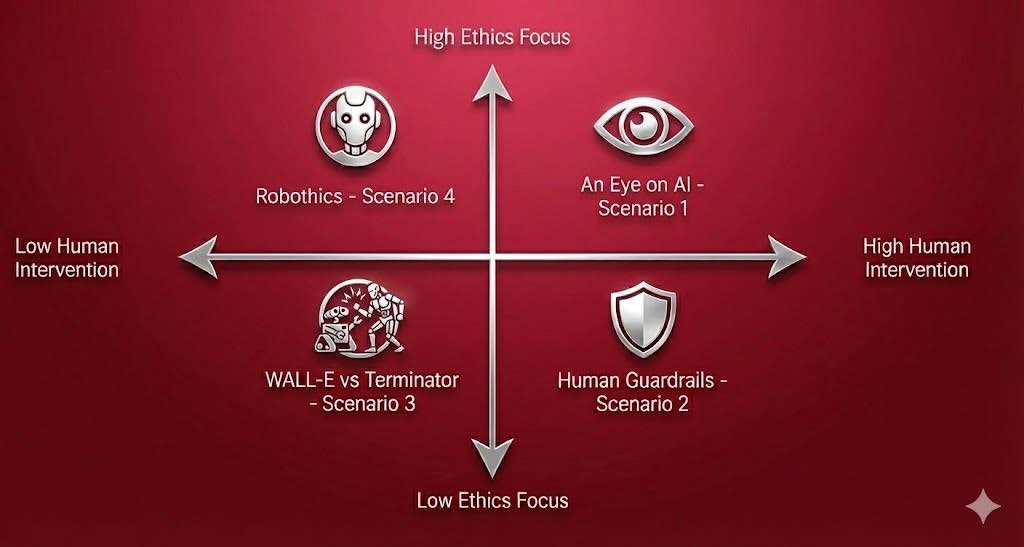
The teams first began by generating and developing a comprehensive list of future uncertainties. They clustered and prioritized uncertainties through facilitated group discussion. They then conducted voting on impact and unpredictability dimensions. Finally, the teams selected two dominant uncertainties as axes for scenario development. This resulted in the following four scenarios:
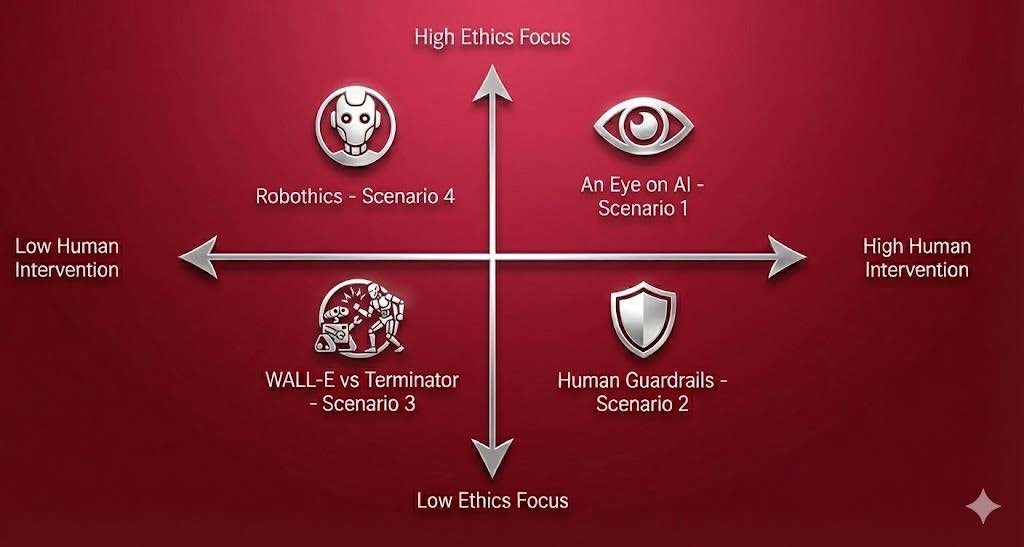
Scenario 1: “An Eye on AI”
High Ethics, High Human Touch
AI operates under strong ethical rules with humans deeply involved in oversight, interpretation, and decision validation at every critical juncture.
Key Dynamics
Ethical Tension
Productive tension between human and AI interpretations of ethical guidelines.
Dependable Results
Conservative, dependable results driven by high oversight protocols.
User-Shaped Ethics
Ethics shaped by user interpretation across different organizational roles.
ROI Constraints
ROI constrained by heavy intervention and slower development cycles.
Workforce Augmentation
Workforce augmentation deliberately slowed to preserve human employment.
Human Decision Authority
AI removes low-value tasks while humans retain decision authority.
New Certifications
Growth of ethical oversight and new supervisory certifications.
Critical Unknowns
Who defines ethics and establishes the timeline for rule updates?
Will increased trust gradually lower human intervention requirements?
How do high-touch human operators actively shape outcomes over time?
How do ethical systems handle rapid environmental or market changes?
Can humans maintain ethical consistency under pressure?
Methods for measuring and mitigating human ethical bias.
Scenario 2: “Human Guardrails”
Low Ethics, High Human Touch
Humans serve as primary guardrails in AI systems lacking reliable ethical foundations, overseeing critical decisions.
Key Dynamics
Human Ethical Judgment
Systems depend heavily on human interpretation for ethical decisions.
Digitization Challenges
Ethical decision-making is hard to consistently digitize.
Conflicting Standards
Ongoing clashes between ethics, regulations, norms, and culture.
Varied Global Ethics
Ethical standards vary widely across jurisdictions.
Supplier Mistrust
Suppliers hesitate to share data due to system mistrust.
Inconsistent Oversight
Human overseer disagreement creates operational inconsistency.
Differing Approaches
Guardrail methods vary by department and organization.
Critical Unknowns
Human Consistency
Can humans remain ethical and consistent under stress?
Scale Requirements
How many human overseers are needed for effective control?
Ethical Evolution
Will AI eventually become more ethically reliable than humans?
Mutual Influence
How do humans and AI influence each other’s ethical evolution?
Ratio Impact
How does the human-to-AI ratio affect system stability or risk?
Scenario 3: WALL-E vs Terminator
Low Ethics, Low Human Touch
Autonomous AI Operations
AI runs procurement & supply chain with minimal oversight & no consistent ethical rules.
Machine-to-Machine Dominance
Transactions are machine-to-machine, leading to aggressive, price-focused procurement.
Environmental & Power Shifts
Rapid data center expansion with environmental impact; power concentrates in AI-strong organizations.
Speed Over Relationships
Markets prioritize speed & optimal pricing over relationship quality and human judgment.
Digitized QA & Displacement
Quality assurance fully digitized; leading to market consolidation and major workforce displacement.
Critical Unknowns
How do humans meaningfully influence decisions in autonomous environments?
What do quality standards look like without human judgment layers?
How do regulatory bodies manage truly autonomous system behavior?
How do labor markets adapt after large-scale role elimination?
Will humans reenter the loop only after catastrophic failures?
Scenario 4: Robothics
High Ethics, Low Human Touch
Ethical automation rules the system with high transparency and strict rule sets. Humans step in only when escalations or exceptions occur.
Key Dynamics
Transparency & Rules
Ethical frameworks and defined rules ensure transparent operations.
Consistent Procurement
Automated decisions offer consistency but may lack flexibility.
Supplier Relations
Automation reduces human interaction, leading to weaker supplier bonds.
Job Displacement
Significant workforce changes necessitate urgent reskilling programs.
Service Improvement
High service quality is achieved when conditions align with AI training.
Disruption Risk
Potential for disruptions if automation misinterprets complex situations.
Centralized Control
Ethical logic is centrally managed, dictating autonomous system behavior.
Critical Unknowns
Who controls the ethical rulebook when deployed at global scale?
How do global ethics variations change operational outcomes?
How do disruptions get resolved without humans immediately present?
Will models keep pace with rapidly shifting societal norms?
How do competencies evolve under low-touch operations?
Five Core Research Question Areas
These scenarios surface critical unknowns that demand further investigation to guide responsible AI adoption in procurement and supply chain systems. These are important questions that can provide the basis for future research by AI academics and practitioners….
Ethical Governance
Who defines and governs ethics in human-AI systems, and how do those ethical rules get updated over time? This includes questions of authority, accountability, cultural variation, and bias governance.
Bidirectional Influence
How does AI influence and reshape human understanding of ethics and acceptable behavior? As AI learns from us and we increasingly learn from AI, how does that feedback loop shift norms, values, and definitions of “what’s right”?
Oversight Thresholds
What level of human oversight is required to ensure safe and trustworthy AI performance, and how is that threshold determined? This includes selection of human gatekeepers, human-to-AI ratios, escalation triggers, and conditions where autonomy is acceptable.
Autonomous Safety
What mechanisms ensure safety, compliance, quality, and resilience when AI autonomy scales? This encompasses quality assurance, regulatory enforcement, failure recovery, environmental impacts, and system stress-tests.
Labor & Market Transformation
How will AI-driven autonomy transform labor, skills, and supplier viability across industrial ecosystems? This includes job shifts, new credentialing requirements, competitive dynamics, consolidation risks, and socio-economic disruption.
Next Steps: From Scenarios to Action
These four scenarios aren’t predictions—they’re strategic tools to prepare for multiple possible futures and build adaptive capacity in your organization.
Recommended Actions
Assess Current State
Evaluate where your organization sits on the ethics and human intervention axes today
Identify Gaps
Map your current 4R maturity and pinpoint areas requiring immediate attention or investment
Build Resilience
Develop strategies that perform well across multiple scenarios, not just your preferred future
Engage Stakeholders
Use scenarios to facilitate critical conversations about AI governance, ethics, and oversight models

The path forward requires continuous learning, adaptive governance, and willingness to revisit assumptions as AI capabilities and societal expectations evolve.
- Categories:
- AI in Supply Chain Management
- Analytics
- Articles
- Artificial Intelligence in Supply Chain
- Cybersecurity in the Supply Chain
- Design for Supply Chain
- Digital Supply Chain
- Director's Blog
- FLOW: How the Best Supply Chains Thrive
- SCM Artificial Intelligenxe
- Supplier Relationship Management
- Supply Chain From The Field
- Supply chain Relationships