Recent discussions with executives have really got me thinking about what the future state of AI applications in supply management might look like. We are also holding a Symposium on December 3, in partnership with the World Commerce and Contracting Institute, which will further explore what some of these “future state” applications might look like.
One of the most promising applications of AI will be in the use of robotic process agents (RPA’s), which can be enormously helpful in enabling current procurement processes to be more flexible. For example, buyers are always on the hook to be monitoring suppliers, deliveries, due dates, etc, and the likelihood of someone “missing” something is high. This might include any number of different actions, such as checking acknowledgements, need by dates, things changing, reminding emails asking if anything has changed, whether due dates for delivery is still correct?, etc. These types of “busy work” activities can be enabled by robotic agents, which can be coordinated to a delivery schedule of supplier orders. The nice thing about AI agents, is the more you utilize them, the better they get at their tasks.
I spoke with a company that does not have a logistics function within their business. So their buyers were having to consistently reach out to suppliers, and asking them if their deliveries are on schedule, and can you email me when you issue a bill of lading? Today, agents are able to request the information from the supplier, and transfer the BOL to a carrier with a tracking feature, and update the delivery schedule in real-time. The agents then manipulate this data to create a dashboard so sites know what 7 deliveries are coming in on trucks on which day, and what time to expect them! By utilizing AI agents for these activities, the company has effectively developed a logistics arm for its business, without flexing a lot of muscle and investment!
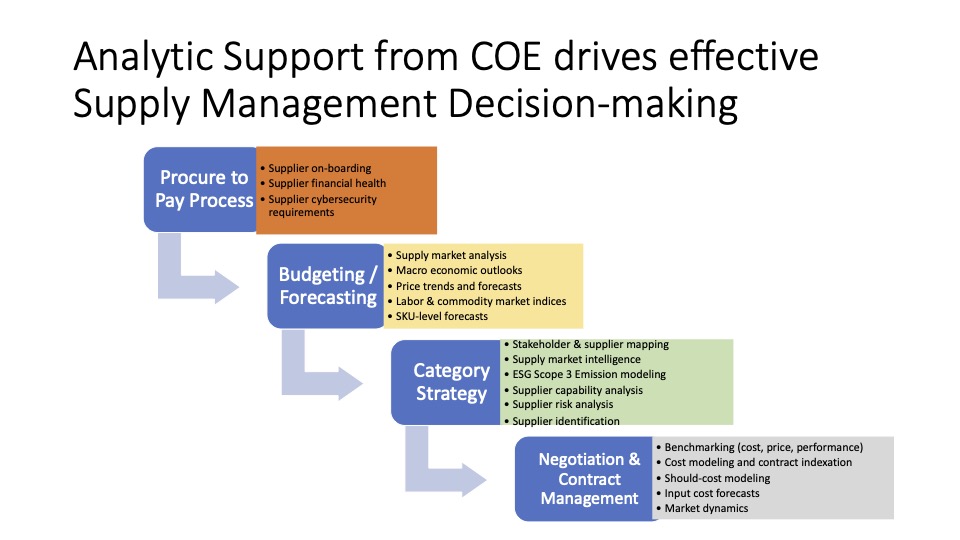
Another important application of AI in supply management is the ability to understand the market conditions for key suppliers. AI applications are beginning to do this, where in the application can take a SOW or RFQ, and identify five strong supplier companies that should be included on the list of recipients of the RFQ. The agent can then receive all of the supplier quote responses, and is able to organize them into a prioritization list – identifying what are the lead times for each supplier, the costs, the quality record based on past orders, and other qualifying criteria. Based on these data, an evaluation scorecard is created, allowing the agent to recommend which supplier or suppliers should be selected, and how to award the business. Similarly, if there are multiple SKU’s going out, it may decide then how to allocate the award among the suppliers. AI engines can also manage an auctioning tool which runs the bidding process, and uses gaming theory to tell suppliers where they stand (e.g. “you are in the top 2 bids”), and ask suppliers for a best and final bid, then aggregate the results and makes a recommendation to the buyer. These types of tools can take hours out of a buyer’s day, and allow them to allocate more time to strategic activities.
Once the business is awarded, AI can then operate in the background to manage PO acknowledgements coming in. It can also be used to monitor deliveries, invoice payments, quantity discounts, and multiple other types of optimization decisions. In other words, AI can create supplier management systems that work for the supplier – and thereby makes them more efficient.

And this is a point that is often overlooked. The purpose of AI is NOT to reduce the workforce and get rid of talented individuals. We have to think more broadly, and grow the skills and capabilities of our procurement workforce. We need to grow our companies without expanding our workforce at the same rate. We can leverage AI and RPA technology to allow people to become more strategic and purposeful in their daily work, and spend less time expediting, handling emergencies, and fighting fires. Adding agents to take over routine mundane skills can then be used to monitor process flows of activities, and summarize them in a control tower. Metrics can be updated based on monitors of what the agents are doing, what the bidding is looking like, and reverting to managers to take action and final decision making . Suddenly the manager is actively engaged in what is going on, and they know what requisitions are out for bid, and are managing delivery dates and events at a high level, instead of being down in the weeds. People can become more efficient and deliberate with their actions. This is an ideal state compared to the current state, where buyers are immersed daily in a world that is so heavily dependent on emails without ever facilitating actual human interaction.
This leads me to my final point. By “strategic activities”, one of the activities that rises to the top of this list is having actual conversations with suppliers. Today, more organizations are recognizing that such conversations can lead to innovation, process improvement, increased responsiveness, improved market intelligence, avoiding and predicting advance notice of supply chain disruptions, and many other benefits. Today, buyers and category managers likely spend only 15% of their time having such conversations. We need to raise this to at least 35%. Such conversations can focus on what our suppliers are doing to control for tariffs in their tier 2 suppliers, what key negotiation points can be applied, and what other joint strategies can be used to navigate the current environment. But this can’t be achieved, without giving people back 35% of their day.